

The selection of a sheave for a wire rope is a critical decision in various industrial applications, including cranes, elevators, and mining equipment. One of the most significant factors influencing this selection is the diameter of the wire rope. In this blog post, I'll explore how the wire rope diameter affects the sheave selection, drawing on my experience as a wire rope sheave supplier.
Understanding the Basics of Wire Rope and Sheaves
Before delving into the relationship between wire rope diameter and sheave selection, it's essential to understand the basic functions of these components. A wire rope is a flexible and strong cable made of multiple strands of wire twisted together. It is used for lifting, pulling, and supporting loads in many industrial settings. A sheave, on the other hand, is a grooved wheel that the wire rope runs over. Its primary function is to guide the wire rope, change its direction, and provide mechanical advantage.
The Importance of the Wire Rope - Sheave Diameter Ratio
The diameter ratio between the wire rope and the sheave is a crucial parameter in sheave selection. This ratio, often referred to as the D/d ratio (where D is the sheave diameter and d is the wire rope diameter), significantly impacts the service life and performance of the wire rope.

A higher D/d ratio generally leads to a longer wire rope life. When the wire rope bends around a sheave, the outer wires on the convex side of the bend are stretched, while the inner wires on the concave side are compressed. A larger sheave diameter reduces the bending stress on the wire rope, minimizing wear and fatigue. For example, in a high - load application like a Hot Rolling Crane Sheave, a proper D/d ratio can prevent premature wire rope failure, which could lead to costly downtime and safety hazards.
Industry standards often recommend specific D/d ratios based on the application. For general hoisting applications, a D/d ratio of 18:1 to 20:1 is commonly suggested. In more critical applications, such as in STS Crane Forged Sheave used in port cranes, a higher ratio of 25:1 or more may be required to ensure reliable and long - term operation.
Sheave Groove Size and Wire Rope Diameter
The size of the sheave groove is directly related to the wire rope diameter. The groove should be sized appropriately to accommodate the wire rope without excessive clearance or pinching.
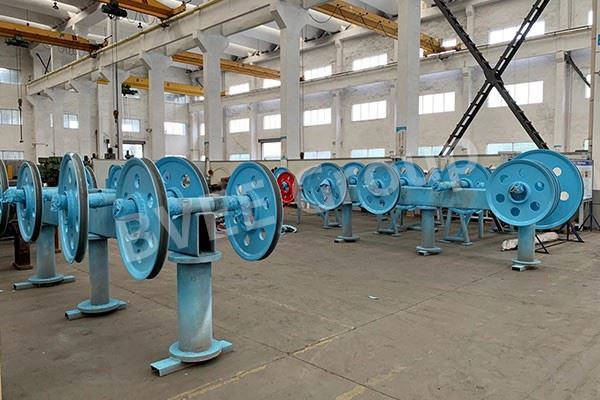
If the groove is too large, the wire rope may not be properly supported, leading to lateral movement and uneven wear. This can cause the wire rope to jump out of the groove, especially under high - speed or high - load conditions. On the other hand, if the groove is too small, it can cause excessive squeezing of the wire rope, increasing internal friction and accelerating wear.
As a wire rope sheave supplier, we carefully design the groove profile and size based on the wire rope diameter. For example, for a wire rope with a specific diameter, we calculate the optimal groove radius to ensure a snug fit that distributes the load evenly across the wire rope strands.
Wire Rope Construction and Sheave Selection
The construction of the wire rope also plays a role in sheave selection in relation to its diameter. Different wire rope constructions, such as 6x19, 6x37, or 8x19, have different flexibility and load - carrying capabilities.
A more flexible wire rope, like a 6x37 construction, may require a slightly larger sheave diameter compared to a less flexible 6x19 rope of the same diameter. This is because the more flexible rope has more individual wires, which need more room to bend without excessive stress. In applications where a Catenary Trolley Rope Tensioner Device is used, the wire rope construction and diameter must be carefully considered to select the appropriate sheave for smooth operation.
Load Capacity and Wire Rope Diameter
The load capacity of the wire rope is closely related to its diameter. A larger - diameter wire rope can generally carry a heavier load. When selecting a sheave, it's essential to ensure that it can handle the load transmitted through the wire rope.

The sheave must be designed with sufficient strength and durability to withstand the forces exerted by the wire rope. This includes not only the static load but also the dynamic loads that occur during operation, such as acceleration, deceleration, and shock loads. For example, in a heavy - duty crane application, a larger - diameter wire rope is used to carry the heavy loads, and a corresponding large - diameter sheave with high - strength materials and proper design is required to ensure safe and efficient operation.
Speed and Wire Rope Diameter
The operating speed of the wire rope also affects sheave selection in relation to its diameter. At higher speeds, the wire rope experiences more centrifugal force, which can cause it to lift out of the sheave groove if not properly supported.
A larger - diameter sheave can help to reduce the centrifugal force acting on the wire rope at high speeds. Additionally, the groove design may need to be optimized for high - speed operation. For instance, in high - speed elevator systems, the wire rope diameter and sheave selection are carefully coordinated to ensure smooth and quiet operation, minimizing vibration and noise.
Environmental Factors
Environmental factors such as temperature, humidity, and the presence of corrosive substances can also influence the relationship between wire rope diameter and sheave selection.
In corrosive environments, a larger - diameter wire rope may be more resistant to corrosion due to its greater cross - sectional area. However, the sheave material and coating must also be selected to resist corrosion. For example, in marine applications, stainless - steel sheaves or sheaves with special anti - corrosion coatings may be required to work in conjunction with the wire rope.
Cost Considerations
Cost is always a factor in any industrial decision. While a larger - diameter sheave may offer better performance and longer wire rope life, it also comes with a higher cost. As a wire rope sheave supplier, we work with our customers to find the right balance between performance and cost.

In some cases, a slightly smaller D/d ratio may be acceptable if the application has a lower duty cycle or if the cost savings are significant. However, it's important to ensure that the selected sheave and wire rope combination still meets the safety and performance requirements of the application.
Conclusion
In conclusion, the diameter of a wire rope has a profound impact on the selection of a sheave. Factors such as the D/d ratio, sheave groove size, wire rope construction, load capacity, speed, environmental factors, and cost all need to be considered.
As a wire rope sheave supplier, we have the expertise and experience to help you make the right sheave selection based on your specific wire rope diameter and application requirements. Whether you need a Hot Rolling Crane Sheave, an STS Crane Forged Sheave, or a Catenary Trolley Rope Tensioner Device, we can provide you with high - quality products and professional advice.
If you're in the process of selecting a sheave for your wire rope application, we encourage you to contact us for a detailed discussion. Our team of experts is ready to assist you in making the best decision for your project.
References
- Machinery's Handbook, 31st Edition
- American Society of Mechanical Engineers (ASME) standards for wire ropes and sheaves
- Wire Rope Users Manual by the Wire Rope Technical Board


