

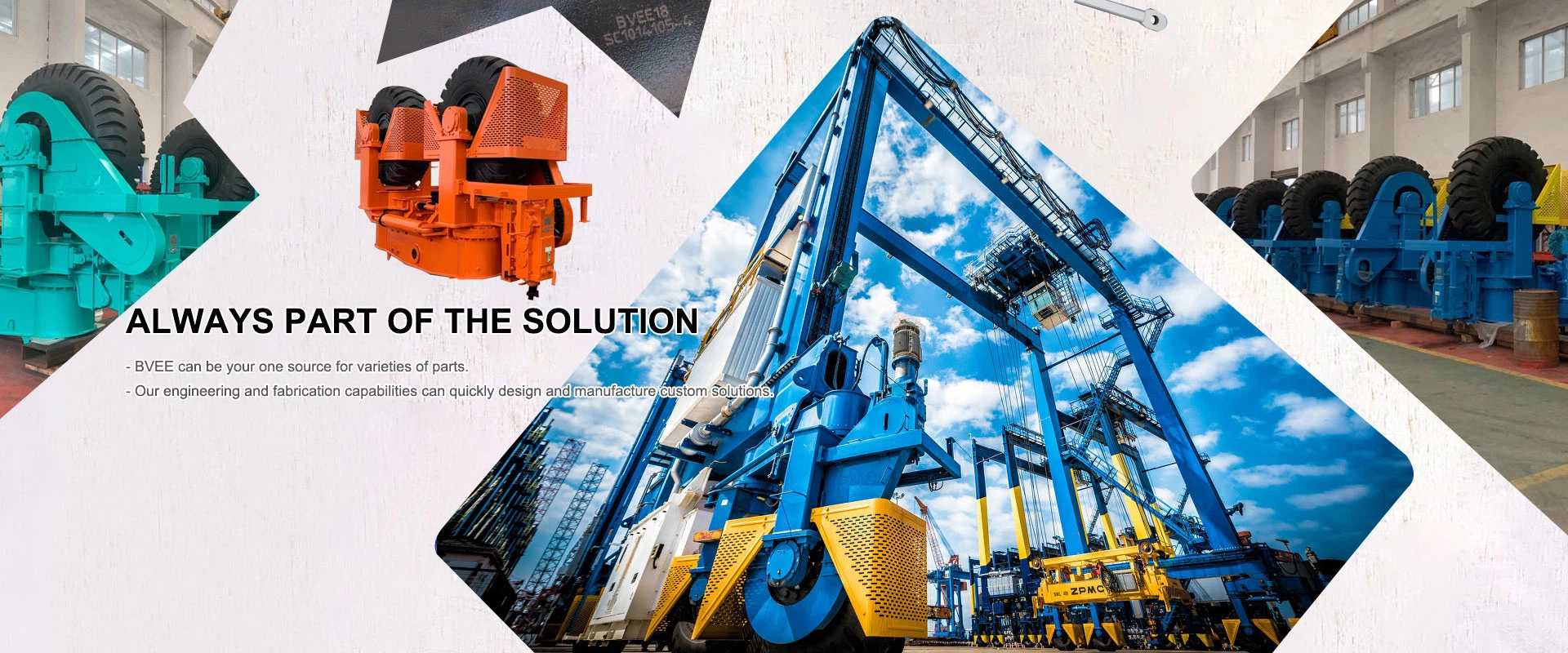


Port Equipment Wheel
BVEE has accumulated many experiences in all types of handling equipment and port machinery over 20 years. BVEE provides innovative, efficient and continuous heavy bulk material treatment solutions for global customer through comparative analysis, combined with actual working conditions and professional technology. And always developing intelligent mobile material handling equipment to replace the rail stacker and traditional loading and unloading process in the yard of port terminal to improve efficiency, reducing cost, lessening pollution and helping the port industry develop in a way of efficient, energy-saving and environment friendly. BVEE also with more activities like: Fabrication and Machining Spare Parts, Maintenance and Repair service, Modification, Erection, Commissioning, Inspection, Calculation and Analysis, Dismantling and Disposal.
Our Advantages
Wide Range of Applications
Our products, such as Port Equipment Wheel, Crane Sheave, Crane Rail, Hoist Drum, Gantry Crane, Container Spreader, Crane Cabin, and Stacker Reclaimer, are widely used in the range of transporting Iron & ore, coal and etc. in various mines, ports and storage yards.
Rich Products
Our company produce a wide variety of Bulk material handling equipments and port equipment, including Port Equipment Wheel, Crane Sheave, Crane Rail, Hoist Drum, Gantry Crane, Container Spreader, Crane Cabin, and Stacker Reclaimer.
24-Hour Service
Our company promises to provide 7×24 hours service after the contract is signed. We will respond within 1 hour after receiving the message, provide solutions to general faults within 8 hours, and solve complex problems within 24 hours.
Quality Guaranteed
Our company has passed ISO quality certification system. Our company has obtained certificates such as ISO14001:2015, ISO9001:2015. All products are strictly tested in accordance with industry standards and contract agreements before leaving the factory.

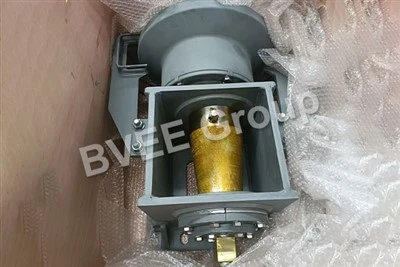


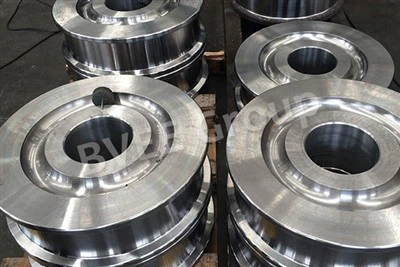
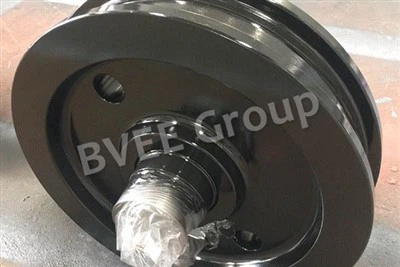


Port Equipment Wheel is a component of Port equipment. Port equipment is the key to efficient cargo handling at both seaports and inland harbors. It includes a range of ship to shore cranes, mobile harbour cranes, fixed pedestal and rail-mounted travelling cranes.
Types of Cranes with Port Equipment Wheel
Rubber-Tired Gantry Cranes (RTG)
A rubber tired gantry crane, RTG, are gantry cranes outfitted with rubber tires for unimpeded movement around the container yard. They primarily move and stack containers throughout the port after the containers have been unloaded from ships or to stage containers in preparation of loading operations. Power is provided typically with a diesel engine, although fully electric versions are becoming common. Power and control to the gantry hoist is primarily routed through cable carriers.
Rail Mounted Gantry Cranes (RMG)
A rail mounted gantry crane, RMG, are very similar to RTG, with the biggest difference being the use of rails for movement rather than free movement with tires. Non-cantilever, single and double cantilever options are all possible. They’re often larger than RTG cranes and require more robust data communication capabilities due to additional onboard equipment and automation functionality. Like an RTG, power and control to the gantry hoist is primarily routed through cable management systems. Typically, RTG can handle stacks of three to four containers high and six rows wide.
Automatic stacking cranes (ASC)
ASC are essentially fully automated RMG without an operator. They’re both gantry cranes that utilize rail mounted movement and are available in similar sizes. The major difference between the two is that ASC are fully automated, improving their efficiency and overall productivity. This makes them ideal for large terminals that require high throughput and stacking density.
Ship-To-Shore Cranes (STS)
STS cranes —sometimes referred to as quay cranes— are typically the largest of port gantry cranes and are used to load and unload containers from ships the shore or berth. This limits them to being installed along the waterside on rails spanning the length of the berth. There are two main types of ship-to-shore cranes: low profile and high profile. Low profile STS cranes have a non-pivoting telescopic boom that extends out from the crane and over ships, where it’s used to load and unload the vessels. High profile STS cranes have a hinged boom that makes navigation easier for ships during berthing.
Examples of Port Equipment Wheel
Description
Port Crane Spare Parts Wheel is a mechanical device. Port Crane Spare Parts Wheel is generally used for the vehicle to support the crane and the load, and at the same time, the crane is allowed to perform the reciprocating running operation on the specified track.
Benefits
●Monumental Lifting Capacity:One of the most striking advantages of Port Cranes is their awe-inspiring lifting capacity. These behemoths are engineered to hoist and maneuver colossal containers, often weighing up to hundreds of metric tons. This capability allows for the swift and seamless transfer of cargo between vessels and the shore.
●Swift Loading and Unloading Operations:Port Cranes excel in expediting loading and unloading processes. Their advanced lifting and trolley systems, coupled with precise control mechanisms, ensure that containers are efficiently moved from ships to the port or vice versa. This rapid turnover time translates into higher throughput for ports, reducing vessel turnaround times.
●Precision and Control:Port Cranes are equipped with state-of-the-art control systems that provide operators with unparalleled precision and accuracy. This enables them to position containers with pinpoint control, even in adverse weather conditions or congested terminal areas. The result is a reduction in mishandling and damage to cargo.
●Versatility in Container Sizes:These cranes are designed to handle a wide range of container sizes, from standard 20-foot containers to the larger 40-foot and high-cube variants. This adaptability allows ports to efficiently manage a diverse array of cargo, accommodating the evolving needs of the shipping industry.
●Height and Outreach:Port Cranes are equipped with towering booms and long outreach capabilities. This enables them to service vessels of varying sizes, including some of the largest container ships in the world. Their height also provides them with a commanding view of the entire port area, ensuring efficient container movement.
Description
Rail Mounted Gantry Crane Wheel is used in gantry cranes. Gantry cranes, also known as portal cranes or overhead traveling cranes, are essential tools in various industrial settings, offering a wide range of benefits and applications. These versatile lifting devices are particularly popular in manufacturing, construction, and logistics industries.
Applications
●Construction Sites:Rail Mounted Gantry Cranes are frequently seen on construction sites, aiding in the assembly of structures such as buildings, bridges, and even ships. These cranes can be moved easily to different locations on the site, which is especially useful for high-rise construction. They are employed for lifting heavy construction materials, equipment, and tools, streamlining construction processes and enhancing efficiency. Rail Mounted Gantry Cranes are critical in ensuring timely project completion.
●Warehouses and Logistics:In warehouse and logistics operations, Rail Mounted Gantry Cranes are used for loading and unloading cargo from trucks and ships. They facilitate the movement of goods within the warehouse, reducing handling time and minimizing the risk of damage to products. With their ability to span wide areas, Rail Mounted Gantry Cranes can efficiently manage inventory and improve storage space utilization in large warehouses.
●Ports and Shipping Yards:Rail Mounted Gantry Cranes are a common sight at ports and shipping yards, where they are used for the loading and unloading of shipping containers from vessels. These cranes can lift containers weighing several tons and position them accurately on trucks or trains for further transportation. Rail Mounted Gantry Cranes help maintain the smooth flow of goods in and out of ports, contributing to the global supply chain.
●Aerospace Industry:The aerospace industry relies on Rail Mounted Gantry Cranes for the assembly and maintenance of aircraft. These cranes are used to position aircraft components, engines, and entire aircraft during the manufacturing process. Rail Mounted Gantry Cranes ensure precision in assembly and play a crucial role in the safety and integrity of aircraft production.
●Power Plants and Energy Sector:Rail Mounted Gantry Cranes are instrumental in power plants, where they are used for the installation and maintenance of heavy machinery and equipment, such as turbines and generators. They help reduce downtime and ensure the continuous operation of power-generating facilities. Rail Mounted Gantry Cranes also play a role in the construction of renewable energy infrastructure, such as wind turbine installations.
●Mining and Extractive Industries:In mining and extractive industries, Rail Mounted Gantry Cranes are employed for handling heavy loads, including ore and raw materials. These cranes streamline the mining process by efficiently moving materials from extraction sites to processing facilities. They are essential for maintaining the productivity and profitability of mining operations.
Description
42CrMo Forged Wheel Sets are manufactured from a billet, or a large square piece of solid metal. The billet is heated to extreme temperatures and pressurized to take its shape. This thermal cycle process causes forged wheels to be stronger than cast wheels due to grain refinement. Consistent forging makes for stronger structural integrity with less material compared to a cast wheel, however the process costs more.
Benefits of Cranes with 42CrMo Forged Wheel Sets
●Faster Construction Times: With the use of cranes, construction projects can be completed faster and more efficiently. This is because cranes can lift and move heavy loads much faster than manual labour. Cranes can pick up and move materials that are too heavy or bulky for human workers, giving construction crews the ability to work faster and more accurately. For example, a construction project that would have taken months to complete using manual labour can be completed in a matter of weeks with the use of cranes. This not only saves time but also reduces the overall cost of the project, as fewer labour hours are needed.
●Improved Material Handling: Cranes also improve material handling on construction sites. With the ability to move heavy loads quickly and efficiently, construction crews can keep materials organized and stored in designated areas, making it easier to access them when needed. Improved material handling not only speeds up construction times but also makes construction sites safer by reducing clutter and trip hazards. Furthermore, cranes can be used to transport materials vertically, which is especially useful in high-rise construction projects. This eliminates the need for workers to carry heavy materials up multiple flights of stairs, reducing the risk of injury and fatigue.
●Reduced Labor Costs: Using cranes also reduces labour costs on construction projects. Without cranes, construction crews would have to rely on more manual labour, which is more time-consuming and expensive than using a truck crane. Cranes can also replace the need for specialized workers, reducing the labour costs associated with hiring someone for a specific task. In addition, cranes can be operated by a single person, which further reduces labour costs. This means that fewer workers are needed to operate the overhead crane itself, freeing up other workers to focus on different tasks.
●Improved Safety: Cranes also improve safety on construction sites. By reducing the need for manual labour, cranes reduce the risk of injury to workers. Cranes also have safety features such as limit switches, which prevent the crane from lifting loads that are too heavy, and anti-two block devices, which prevent the crane from colliding with itself. Furthermore, cranes can be equipped with cameras and other monitoring systems, which allow operators to have a better view of the construction site and detect potential hazards before they become a problem.
Description
STS Crane Trolley Wheel is a pivotal system of components. It travels along the bridge, providing the initial horizontal movement. Trolleys can be customized to accommodate various hoists with different lifting capacities which gives a crane its vertical motion.
Benefits
●Reduced Fatigue And Improved Ergonomics: Manual handling is not only exhausting and lowers short-term productivity, but it also causes serious injuries due to poor ergonomics. An electric lifting trolley efficiently removes the demanding aspects of lifting from the equation, which enables a more ergonomic work environment. This, in turn, improves employee health and productivity.
●Appropriate For Many Types Of Loads: An STS Crane Trolley Wheel effectively removes the demanding elements of lifting from the equation, which enables a more ergonomic work environment. This, in turn, improves employee health and productivity. By choosing the right tools for your STS Crane Trolley Wheel, you can use them for various manual lifting tasks. Such as ergonomic lifting of boxes, drums, reels, crates, and many other common loads.
●Reduced Risk Of Accidents And Injury When Using a STS Crane Trolley Wheel: Using trolley lifting equipment dramatically reduces the risk of severe injuries from material handling accidents. Stretching for materials puts operators at an increased risk of injury. Hence, using a trolley that will help you get to items that are impossible to access with other types of lifting equipment, is a much safer alternative. So by using trolleys, you’ll improve ergonomics, which has positive long-term health effects.
●Protection Of Transported Goods: Manual handling often ends up damaging the goods being lifted and moved. This is obviously both inconvenient and costly but can be avoided. Instead, a trolley will securely lift and carry heavy and cumbersome goods, effectively avoiding procedures that risk damaging materials.
●Increased Productivity: From a business perspective, STS Crane Trolley Wheels tend to be an excellent investment. They will reduce cycle times and enhance productivity in almost any industrial or manufacturing setting. Alone or in combination with other handling equipment.
●Outstanding Movability And Flexibility: The compact and lightweight design of a trolley are ideal for material handling in areas where space is limited. Especially compared to full-size lift trucks. They are also helpful where goods may be hard to reach. In addition, a trolley takes up very little space when not in use.
Certificate
