

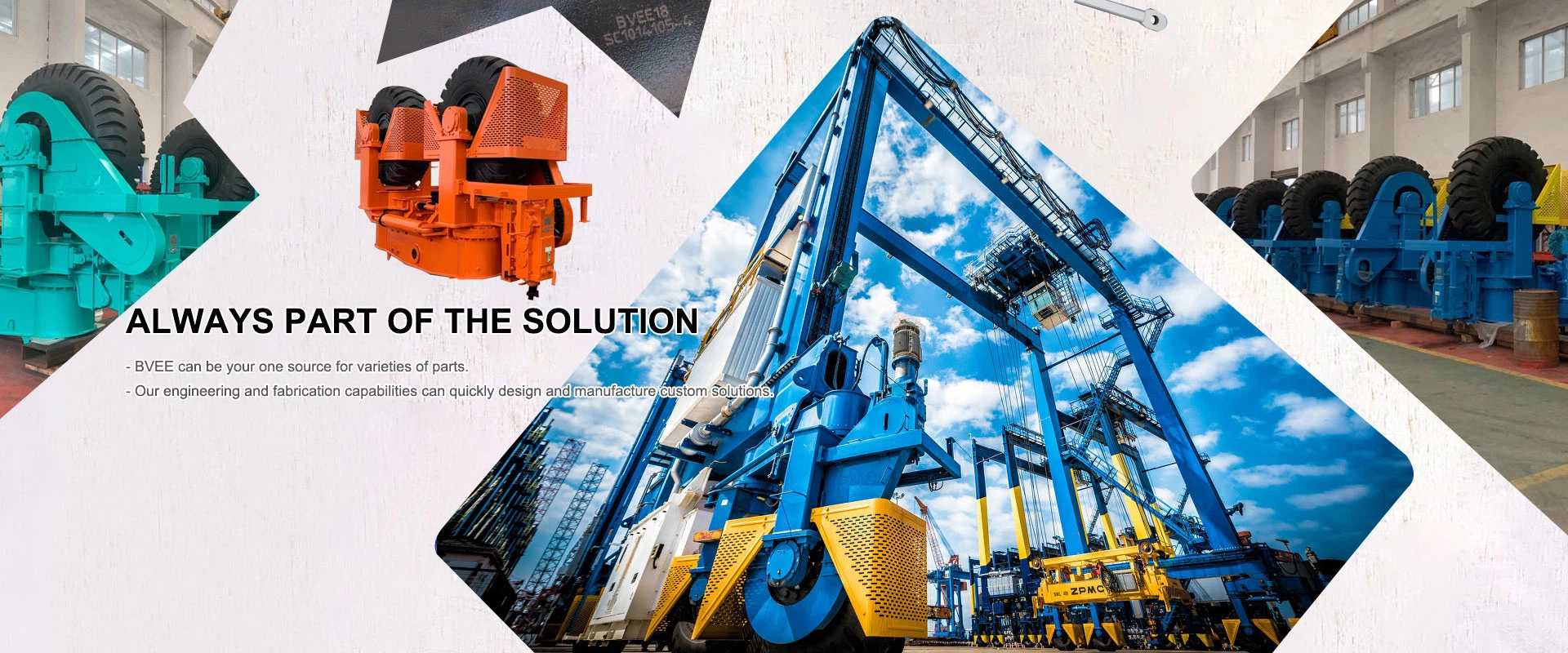


Container Spreader
BVEE has accumulated many experiences in all types of handling equipment and port machinery over 20 years. BVEE provides innovative, efficient and continuous heavy bulk material treatment solutions for global customer through comparative analysis, combined with actual working conditions and professional technology. And always developing intelligent mobile material handling equipment to replace the rail stacker and traditional loading and unloading process in the yard of port terminal to improve efficiency, reducing cost, lessening pollution and helping the port industry develop in a way of efficient, energy-saving and environment friendly. BVEE also with more activities like: Fabrication and Machining Spare Parts, Maintenance and Repair service, Modification, Erection, Commissioning, Inspection, Calculation and Analysis, Dismantling and Disposal.
Our Advantages
Wide Range of Applications
Our products, such as Port Equipment Wheel, Crane Sheave, Crane Rail, Hoist Drum, Gantry Crane, Container Spreader, Crane Cabin, and Stacker Reclaimer, are widely used in the range of transporting Iron & ore, coal and etc. in various mines, ports and storage yards.
Rich Products
Our company produce a wide variety of Bulk material handling equipments and port equipment, including Port Equipment Wheel, Crane Sheave, Crane Rail, Hoist Drum, Gantry Crane, Container Spreader, Crane Cabin, and Stacker Reclaimer.
24-Hour Service
Our company promises to provide 7×24 hours service after the contract is signed. We will respond within 1 hour after receiving the message, provide solutions to general faults within 8 hours, and solve complex problems within 24 hours.
Quality Guaranteed
Our company has passed ISO quality certification system. Our company has obtained certificates such as ISO14001:2015, ISO9001:2015. All products are strictly tested in accordance with industry standards and contract agreements before leaving the factory.


A container spreader is a tool used for lifting containers and unitized cargo. The Container Spreader is placed between the container and the lifting machine. The Container Spreader used for containers has a locking mechanism at each corner that attaches to the four corners of the container. A Container Spreader can be used on a container crane, a straddle carrier and with any other machinery to lift containers. Container Spreader operation can be manual, semiautomatic or fully automatic.
Advantages of Container Spreader
Remove The Need For Operators To Work On Top Of Containers
While this is now banned in many ports, there are still some instances where staff are operating on top of containers. A container spreader with twist locks removes the need for this entirely which will reduce the risk of accidents.
Improve The Efficiencies Of Staff
Using a container spreader at your port reduces the time taken for lifting each container which will allow for higher productivity compared to using a traditional crane. Your staff are less likely to become fatigued which allows for higher output which, in turn, increases your profit line.
Strong Accessibility & Environmental Protection
The Container Spreader can approach the container door, making the lifting operation more convenient and efficient. The use of the Container Spreader can eliminate the need for transportation tools during transportation, saving a lot of fuel and avoiding air pollution problems.
High Safety
The Container Spreader has a high load-bearing capacity and stability, and will not cause mechanical loss of control due to excessive container weight. Due to its simple operation, it greatly reduces the risk of worker injury.
High Strength
Container spreaders are mainly made of high-strength steel and can withstand high-strength tension, shear and torsion. They are designed and manufactured in strict accordance with industry standards and have high safety and reliability.
Corrosion Resistance
Since containers are in sea transportation all year round, container spreaders need to have strong corrosion resistance. Their surface is generally treated with anti-corrosion, which can effectively prevent oxidation, rust and etching, thereby increasing their service life.
Wide Range Of Application Scenarios
Container spreaders are widely used in shipping, railways, aviation and other fields. They can be used to lift standard 20-foot and 40-foot containers, special containers, oversized containers, etc. In addition, they are also used in industrial and mining enterprises, ports, warehouses and other places.
Top Container Spreader
The top Container Spreader is a commonly used tool in lifting operations. It is widely used in 20-foot, 40-foot standard containers and 40-foot cabinet containers. It can well protect the surface above the container. Its main structure includes a base, a tractor, a frame, a rotating body, a clamp and a crankshaft, etc., which can be locked and started by an electrical or hydraulic system.
Corner Container Spreader
The corner Container Spreader is mainly used to lift non-standardized containers, such as open-top containers, tank containers, etc., and its scope of application is relatively narrow. Its structure is detachable and adjustable. During the installation process, it is necessary to ensure that the clamp is parallel and symmetrical with the four corners of the container to avoid deformation of the container.
Barrel Container Spreader
The barrel Container Spreader is also called a mid-mounted Container Spreader. It is suitable for horizontal and vertical lifting of containers in special scenarios. Its structure is similar to a parallelogram and consists of multiple main parts, including a base, a chain, a clamp and a crankshaft. It is mainly suitable for box structures with large openings and trapezoidal loading platforms.

How To Choose Container Spreader
Carrying Capacity
When choosing a Container Spreader, you need to consider the carrying capacity of the Container Spreader according to actual needs. Generally speaking, the carrying capacity of a hydraulic container crane is between 40 and 60 tons, while a powered container crane can reach 80 to 100 tons. If you need to unload a heavy container, you need to choose a powered container crane.
Stability
Stability is an important factor to consider when choosing a bottom unloading Container Spreader. Some hydraulic container Container Spreaders come with built-in stabilization devices to ensure that the container will not tip over during operation. However, manual container Container Spreaders require the cooperation of multiple people, and it is necessary to ensure that the operators can coordinate and ensure the stability of the Container Spreader.
Ease Of Operation
When choosing a bottom unloading Container Spreader, you need to consider its ease of operation. The operation of a hydraulic container spreader is very simple, just connect the machine and press the operation button. Manual container spreaders require multiple people to cooperate with the operation, which requires high coordination.
Adaptability
When choosing a Container Spreader, you need to consider its scope of application. Hydraulic container spreaders can be used for containers of all shapes and weights, and powered container spreaders can carry larger containers. Manual container spreaders are only suitable for loading and unloading small containers.
Functions of Container Spreader
Fixing Function
As an important part of loading and unloading machinery, the primary function of container spreaders is to fix and stabilize containers to prevent them from moving and tilting under the action of heavy objects. During the lifting process, the Container Spreader must be able to securely fix the container to ensure the smooth unloading operation. The deformation and looseness of the Container Spreader will affect the lifting efficiency, and in severe cases may even lead to accidents.
Suspension Function
Another important function of container spreaders is to suspend containers for easy transportation and loading and unloading. During the lifting process, the Container Spreader can adjust the length and angle of the lifting rope to adapt to the lifting requirements of containers at different heights. The suspension function of the Container Spreader can also help speed up loading and unloading and improve production efficiency.

Lifting Function
The third function of the container spreader is to lift the container and lift it from the ground at a certain height or in different directions for easy transportation and loading and unloading. The structure and selection of the Container Spreader need to take into account the weight and size of the container to ensure the safe lifting of the container.
Safety Guarantee
The last function of the container spreader is to provide safety guarantee for the lifting and transportation process. The selection and use of Container Spreaders must comply with safety standards to avoid risks such as quality problems and structural loss of control. During the use of Container Spreaders, attention should also be paid to details to avoid accidental injuries to personnel and damage to containers.
How A Container Spreader Used To Lift Containers
Cranes must have sufficient outreach to access the containers on the outboard side of the largest ships, which may be stowed up to 24 across. They are fitted with telescopic Container Spreaders so that either 20ft or 40ft units can be lifted easily. Some cranes also fitted with Container Spreaders capable of twin-lifting 20ft containers. Such equipment can usually only operate if containers of the same height are paired. The Container Spreader is fitted with twist locks that enter the apertures in the container's top corner castings and engage when it is turned 90°.
Lifting of a container with ships' gear should properly be carried out using a Container Spreader to ensure that a vertical lift is applied to each top corner casting of the unit. The twist locks of such Container Spreaders may be activated remotely by the crane driver with a sophisticated system or by moving the locking lever on the side of the Container Spreader frame, usually through a rope hanging from the lever. This latter system is referred to as "semi-automatic." The more sophisticated Container Spreader system may also be self-leveling and maintain a parallel line to the ship as the crane, or derrick swings the container on board.
An essential Container Spreader may consist of a steel frame with a wide leg and a hook suspended from each corner. The four hooks can be inserted into the corner castings of a container. It works in such a way that the hook protrudes from the casting. It provides maximum support from the seat of the hook and makes for ease of unhooking when the container is in position. It is a slow labor-intensive procedure as stevedores need to be on top of the container or a ladder against the container in order to hook on and unhook. Consequently, it is also an inherently dangerous operation but may be the norm in unsophisticated ports. A container should never be lifted by direct wire slings from top corner castings without a Container Spreader to prevent the wires pinching and thus causing damage to the unit.
Certificate
