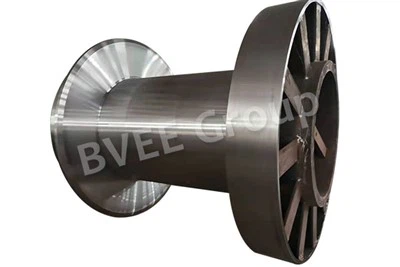
Hey there! As a crane sheave supplier, I often get asked about how to calculate the torque required for a crane sheave. It's a crucial question, especially when you're looking to ensure the smooth and safe operation of your crane. In this blog, I'll break down the process step by step, so you can make informed decisions when it comes to choosing the right crane sheave for your needs.
First off, let's understand what torque is. Torque is basically a measure of the force that can cause an object to rotate around an axis. In the context of a crane sheave, it's the force needed to make the sheave turn and lift or move the load. The torque calculation involves a few key factors, and getting these right is essential for the proper functioning of your crane.

Factors Affecting Torque Calculation
Load Weight
The weight of the load that the crane sheave will be lifting is one of the most significant factors. The heavier the load, the more torque is required to lift it. This is pretty intuitive – if you're trying to lift a really heavy object, you need more force to get it moving. You can usually find the weight of the load in the specifications provided by the manufacturer or by using a weighing scale.
Sheave Diameter
The diameter of the crane sheave also plays a crucial role. A larger diameter sheave generally requires more torque to rotate compared to a smaller one, assuming the same load weight. This is because the force has to act over a larger distance to make the sheave turn. So, when you're choosing a sheave, you need to consider its diameter in relation to the load you'll be handling.
Friction
Friction is another factor that can't be ignored. There's friction between the rope and the sheave, as well as within the bearings of the sheave. This friction can increase the amount of torque needed to turn the sheave. To reduce friction, you can use high - quality lubricants and choose sheaves with low - friction bearings.
The Torque Calculation Formula
The basic formula for calculating torque is (T = F\times r), where (T) is the torque, (F) is the force applied, and (r) is the radius of the sheave (half of the diameter).
When it comes to a crane sheave, the force (F) is related to the weight of the load. If the load is hanging vertically, the force (F) is equal to the weight of the load (W) ( (F = W) ). So, the torque formula becomes (T=W\times r).
However, this is a simplified version. In real - world scenarios, you also need to account for friction. A more accurate formula would be (T=(W\times r)+T_f), where (T_f) is the torque due to friction.
To calculate (T_f), you need to know the coefficient of friction (\mu) between the rope and the sheave, as well as the normal force (N) acting on the sheave. The frictional force (F_f=\mu\times N), and the torque due to friction (T_f = F_f\times r).
Step - by - Step Calculation
Let's go through a step - by - step example of calculating the torque required for a crane sheave.
- Determine the load weight ((W)): Suppose you have a load that weighs 5000 kg. To convert this to force, we use the formula (F = m\times g), where (m) is the mass and (g) is the acceleration due to gravity (approximately (9.81 m/s^2)). So, (W=5000\times9.81 = 49050 N).
- Measure the sheave diameter ((d)) and calculate the radius ((r)): Let's say the sheave has a diameter of 1 meter. Then the radius (r=\frac{d}{2}=0.5 m).
- Estimate the torque due to the load ((T_{load})): Using the formula (T_{load}=W\times r), we get (T_{load}=49050\times0.5 = 24525 Nm).
- Estimate the torque due to friction ((T_f)): Assume the coefficient of friction (\mu = 0.1) and the normal force (N) is equal to the load weight (W) (in a simple case). Then the frictional force (F_f=\mu\times N = 0.1\times49050 = 4905 N). And the torque due to friction (T_f=F_f\times r=4905\times0.5 = 2452.5 Nm).
- Calculate the total torque ((T_{total})): Using the formula (T_{total}=T_{load}+T_f), we get (T_{total}=24525 + 2452.5=26977.5 Nm).
Importance of Accurate Torque Calculation
Accurately calculating the torque required for a crane sheave is crucial for several reasons. Firstly, it ensures the safety of the crane operation. If the torque is miscalculated and the sheave doesn't have enough power to lift the load, it can lead to equipment failure, which can be extremely dangerous.
Secondly, it helps in optimizing the performance of the crane. By choosing a sheave with the right torque capacity, you can ensure that the crane operates efficiently, reducing energy consumption and wear and tear on the equipment.
Our Crane Sheave Offerings
At our company, we offer a wide range of crane sheaves, including the Full Forging Sheave. Our full - forging sheaves are made from high - quality materials, which ensure durability and low friction. They are designed to handle different load weights and are available in various diameters to meet your specific requirements.
When you're choosing a crane sheave, it's important to consider the torque requirements we've discussed. Our team of experts can help you select the right sheave for your application, taking into account all the factors involved in torque calculation.
Contact Us for Purchase
If you're in the market for a crane sheave and want to ensure that you're getting the right one for your torque requirements, don't hesitate to reach out to us. We're here to assist you with any questions you may have and to help you make the best choice for your crane operation. Whether you're a small - scale operator or a large industrial company, we have the right sheave for you.
References
- Machine Design Handbook, various editions.
- Crane Safety and Operation Manuals from industry standards organizations.