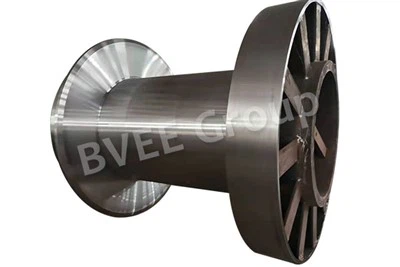
What are the design considerations for a crane rope drum?
As a supplier of crane rope drums, I've witnessed firsthand the critical role these components play in the overall functionality and safety of cranes. A well - designed crane rope drum can significantly enhance the efficiency of a crane, while a poorly designed one can lead to a host of problems, including premature rope wear, reduced load - handling capacity, and even safety hazards. In this blog, I'll discuss the key design considerations for a crane rope drum.
1. Drum Diameter
The diameter of the crane rope drum is a fundamental design parameter. It has a direct impact on the bending stress of the rope. A larger drum diameter results in a lower bending stress on the rope. When the rope bends around a drum, the outer fibers of the rope are stretched, and the inner fibers are compressed. Smaller drum diameters cause higher levels of stress in the rope, which can lead to fatigue failure over time.
For example, if the drum diameter is too small relative to the rope diameter, the rope may experience excessive bending, causing the wires within the rope to break prematurely. Industry standards often recommend a minimum drum diameter - to - rope diameter ratio. For general applications, a ratio of 18:1 to 20:1 is commonly used, but in more demanding applications, a higher ratio may be required. This consideration is crucial to ensure the longevity and reliability of the rope, which is a vital component of the crane's lifting system.
2. Groove Design
The grooves on the crane rope drum are designed to guide the rope as it winds and unwinds. The shape and dimensions of the grooves are carefully engineered to prevent the rope from slipping, rubbing against adjacent turns, and to ensure proper alignment.
There are different types of groove profiles, such as V - shaped, U - shaped, and semi - circular grooves. V - shaped grooves are often used for ropes that require a high degree of lateral stability. They provide good gripping action and help prevent the rope from moving sideways. U - shaped grooves, on the other hand, are more suitable for ropes that need to be seated more securely and are less prone to damage from sharp edges. Semi - circular grooves are a common choice as they offer a balance between gripping force and rope protection.


The pitch of the grooves, which is the distance between adjacent grooves, must also be carefully determined. It should be slightly larger than the diameter of the rope to allow for proper winding and to prevent the rope from overlapping or jamming. Additionally, the depth of the grooves should be sufficient to accommodate the rope without excessive compression, which could lead to premature wear.
3. Material Selection
The choice of material for the crane rope drum is essential for its durability and performance. Common materials used include cast iron, steel, and forged steel.
Cast iron is a popular choice due to its low cost and good casting properties. It can be easily shaped into complex drum designs. However, cast iron has relatively low strength compared to steel, and it may be more prone to cracking under heavy loads.
Steel is a more robust material, offering higher strength and better resistance to wear and fatigue. Welded steel drums are widely used in many crane applications. They can be fabricated to precise specifications and can withstand higher loads. Forged steel drums, on the other hand, are even stronger and more reliable. They are made by shaping the steel under high pressure, which results in a more uniform grain structure and better mechanical properties. However, forged steel drums are more expensive to produce.
When selecting the material, factors such as the operating environment, the load capacity of the crane, and the expected service life of the drum must be considered. For example, in harsh environments with high levels of corrosion, a drum made of corrosion - resistant steel or with a protective coating may be required.
4. Drum Length
The length of the crane rope drum is determined by the amount of rope that needs to be stored on the drum. It is calculated based on the maximum lifting height of the crane, the number of rope layers, and the rope diameter.
The drum should be long enough to accommodate all the rope required for the crane's operation without causing the rope to pile up or overlap in an uncontrolled manner. If the drum is too short, the rope may not be wound neatly, leading to increased wear and the risk of entanglement. On the other hand, an overly long drum can add unnecessary weight and cost to the crane.
When designing the drum length, it's also important to consider the arrangement of the rope layers. Multiple - layer winding can increase the effective storage capacity of the drum, but it also requires careful design to ensure that the rope does not crush or damage the underlying layers.
5. Flange Design
The flanges at the ends of the crane rope drum serve several important functions. They prevent the rope from slipping off the drum during operation, and they also help to guide the rope onto the drum in a controlled manner.
The height of the flanges should be sufficient to contain the rope, especially when the drum is fully loaded. The flanges should also be designed to be smooth and free of sharp edges to prevent damage to the rope. In addition, the flanges may need to be reinforced in high - load applications to withstand the forces exerted by the rope.
Some crane rope drums may have special flange designs, such as tapered flanges or flanges with additional guiding features. These designs can improve the winding and unwinding of the rope, especially in applications where the rope is subjected to lateral forces or where precise alignment is required.
6. Mounting and Alignment
Proper mounting and alignment of the crane rope drum are crucial for its smooth operation. The drum must be securely mounted to the crane structure to prevent excessive vibration and movement during operation.
The alignment of the drum with the hoisting mechanism and the rope guides is also essential. Misalignment can cause the rope to wear unevenly, leading to premature failure. It can also result in increased stress on the drum and other components of the crane.
During the installation process, precise measurements and adjustments should be made to ensure that the drum is correctly aligned. This may involve using alignment tools and following strict installation procedures. Regular maintenance and inspection of the mounting and alignment are also necessary to detect and correct any issues that may arise over time.
7. Safety Features
Safety is of utmost importance in crane design, and the rope drum is no exception. Some safety features that can be incorporated into the design of the crane rope drum include anti - rotation devices, overload protection, and emergency stop mechanisms.
Anti - rotation devices prevent the drum from rotating in the wrong direction, which could lead to the rope becoming entangled or the load being dropped unexpectedly. Overload protection systems can detect when the load on the crane exceeds its rated capacity and prevent further operation to avoid damage to the drum and the crane. Emergency stop mechanisms allow the operator to quickly halt the operation of the drum in case of an emergency.
In addition, the drum should be designed to comply with relevant safety standards and regulations. This includes ensuring that the drum has appropriate markings and labels indicating its capacity, operating instructions, and safety warnings.
As a supplier of crane rope drums, we offer a wide range of products to meet different customer needs. Our Port Crane Spare Parts Drum is designed for use in port cranes, providing high - quality performance and reliability. We also have Port Cable Reel and Port Cable Reel Drum options for specific port - related applications.
If you are in the market for a crane rope drum or have any questions about our products, we encourage you to contact us for a detailed discussion. Our team of experts is ready to assist you in selecting the right drum for your specific requirements and to provide you with professional advice on installation, maintenance, and safety.
References
- American Society of Mechanical Engineers (ASME). (Year). Crane design standards.
- Manufacturer's manuals for various crane models.
- Industry research papers on crane rope drum design and performance.