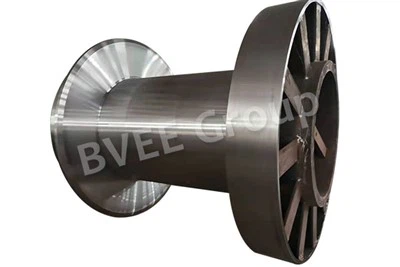
As a wire rope sheave supplier, I often encounter customers who are confused about the differences between fixed and movable wire rope sheaves. In this blog post, I'll delve into these differences to help you make an informed decision when choosing the right sheave for your application.
Structure and Installation
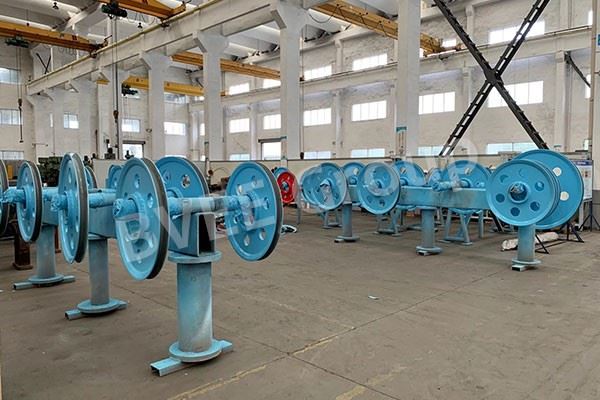
The most obvious difference between fixed and movable wire rope sheaves lies in their structure and installation methods. A fixed sheave is, as the name suggests, fixed in place. It is typically mounted on a stationary axle or shaft, which is securely attached to a frame or structure. This type of sheave does not move during normal operation, except for the rotation of the sheave wheel around its axis. The fixed installation provides stability and is suitable for applications where the direction of the wire rope needs to be changed without the need for the sheave to move along the rope path.
On the other hand, a movable sheave can move along the wire rope or be re - positioned as required. It is usually installed on a carriage or a support that allows it to slide or travel. Movable sheaves are more complex in structure compared to fixed sheaves because they need to incorporate mechanisms for smooth movement. For example, they may have bearings or rollers that enable them to move freely along the wire rope or a track.
Function and Application
The functions of fixed and movable wire rope sheaves also vary significantly, which determines their different application scenarios.
Fixed wire rope sheaves are mainly used for changing the direction of the wire rope. In a lifting system, a fixed sheave can redirect the rope from a vertical to a horizontal direction or vice versa, making it easier to route the rope to the desired location. For instance, in a construction crane, fixed sheaves are often used at the top of the mast to change the direction of the hoisting rope. They are also commonly used in pulley systems for power transmission, where they help transmit force from one part of the system to another by changing the rope's direction. Our Hot Rolling Crane Sheave is a type of fixed sheave that is widely used in crane applications, providing reliable direction - changing function for the wire rope.
Movable wire rope sheaves, however, are used for more advanced functions. One of the key functions of a movable sheave is to provide mechanical advantage in a pulley system. By using a movable sheave in combination with fixed sheaves, a pulley system can reduce the amount of force required to lift a load. This is based on the principle of distributing the load over multiple segments of the wire rope. In a block and tackle system, movable sheaves are used to increase the lifting capacity with less effort. For example, in large - scale industrial lifting operations, such as shipbuilding or heavy - machinery installation, movable sheaves are essential for handling extremely heavy loads. Our STS Crane Forged Sheave can be used as a movable sheave in some advanced crane systems, providing excellent mechanical advantage for heavy - duty lifting tasks.
Load - Bearing Capacity
Load - bearing capacity is another important factor to consider when comparing fixed and movable wire rope sheaves.
Fixed sheaves generally have a relatively high and stable load - bearing capacity. Since they are fixed in place, the forces acting on them are more predictable. The design and construction of fixed sheaves are optimized to withstand the static and dynamic loads that occur during normal operation. They are often made of high - strength materials such as forged steel or cast iron, which can handle heavy loads without deformation. The axle and mounting structure of a fixed sheave are also designed to transfer the load safely to the supporting frame.
Movable sheaves, while also capable of handling significant loads, may have a more variable load - bearing capacity. The movement of the sheave along the wire rope or track can introduce additional dynamic forces, which need to be taken into account in the design. For example, when a movable sheave accelerates or decelerates, there will be inertial forces acting on it. To ensure reliable operation, movable sheaves may require more sophisticated design and higher - quality materials. In some cases, the load - bearing capacity of a movable sheave may be slightly lower than that of a fixed sheave of the same size, but this can be compensated by using multiple movable sheaves in a pulley system.
Maintenance Requirements
Maintenance is an important aspect of using wire rope sheaves, and the requirements for fixed and movable sheaves differ.
Fixed wire rope sheaves are relatively easy to maintain. Since they do not move along the wire rope, there is less wear and tear on the sheave wheel and the mounting components. Regular inspection of the sheave wheel for signs of wear, such as groove wear or surface cracking, is usually sufficient. Lubrication of the bearings is also necessary to ensure smooth rotation. In addition, checking the tightness of the mounting bolts and the integrity of the axle is important to prevent any loosening or failure.
Movable wire rope sheaves, on the other hand, require more comprehensive maintenance. The moving parts of a movable sheave, such as the bearings or rollers that enable movement, need to be inspected and lubricated regularly. The tracks or guides along which the sheave moves also need to be checked for any signs of damage or misalignment. Since movable sheaves are often used in more complex pulley systems, the entire system needs to be inspected to ensure proper operation. For example, our Welding Sheave, which can be used as a movable sheave in some applications, requires careful maintenance to ensure its long - term reliability.
Cost Considerations
Cost is a crucial factor for many customers when choosing between fixed and movable wire rope sheaves.
Fixed wire rope sheaves are generally more cost - effective. Their simpler structure and installation process result in lower manufacturing and installation costs. They also have lower maintenance costs over their lifespan, which makes them an attractive option for applications with a limited budget.
Movable wire rope sheaves are more expensive. The additional complexity in design and the need for high - quality materials and components increase the manufacturing cost. The more comprehensive maintenance requirements also contribute to higher long - term costs. However, in applications where the mechanical advantage provided by movable sheaves is essential, the additional cost may be justified.

In conclusion, the choice between a fixed and a movable wire rope sheave depends on your specific application requirements, including the function needed, load - bearing capacity, maintenance capabilities, and budget. As a professional wire rope sheave supplier, we can provide you with detailed technical advice and high - quality products to meet your needs. If you are interested in our wire rope sheaves or have any questions about choosing the right sheave for your project, please feel free to contact us for further discussion and procurement negotiation.
References
- Machinery's Handbook, Industrial Press Inc.
- Handbook of Lifting and Rigging, McGraw - Hill Education.