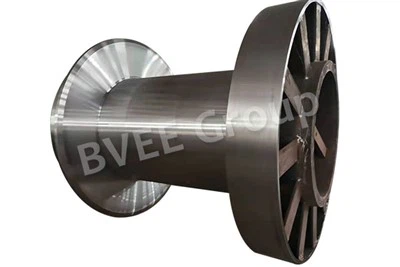
Hey there! I'm a supplier of crane rope drums, and today I wanna chat about something super important: the power consumption of a crane rope drum. You might be thinking, "Why should I care about that?" Well, power consumption can have a huge impact on your operational costs, efficiency, and even the environment. So, let's dive in!
First off, what exactly is a crane rope drum? It's a key component of a crane that winds and unwinds the rope to lift and lower loads. You can find different types of crane rope drums, like the Port Crane Spare Parts Drum and the Port Cable Reel Drum. These drums come in various sizes and designs, depending on the specific requirements of the crane and the loads it needs to handle.


Now, let's talk about power consumption. The power consumption of a crane rope drum is mainly affected by several factors. One of the most significant factors is the load being lifted. The heavier the load, the more power the drum needs to use to wind and unwind the rope. For example, if you're lifting a small, lightweight object, the power consumption will be relatively low. But if you're dealing with a massive, heavy load, the drum will have to work much harder, which means higher power consumption.
Another factor is the speed at which the drum operates. Faster operation usually requires more power. If you need to lift or lower the load quickly, the motor driving the drum will have to supply more energy. On the other hand, if you can afford to operate at a slower speed, you can save a significant amount of power.
The efficiency of the drum itself also plays a crucial role. A well - designed and properly maintained drum will have lower power losses. For instance, a drum with high - quality bearings and a smooth surface will reduce friction, which in turn reduces the amount of power needed to turn it. If the drum is old, worn out, or not maintained properly, it can cause more resistance and increase power consumption.
Let's take a closer look at how we can calculate the power consumption of a crane rope drum. The basic formula for power (P) is P = W/t, where W is the work done and t is the time taken. The work done in lifting a load is equal to the force (F) applied multiplied by the distance (d) moved. In the case of a crane rope drum, the force is the weight of the load being lifted, and the distance is the height the load is lifted.
So, if we know the weight of the load (W = mg, where m is the mass and g is the acceleration due to gravity), and the height it's lifted, we can calculate the work done. Then, by dividing the work done by the time taken to lift the load, we can get an estimate of the power consumption. However, this is a simplified calculation. In real - world scenarios, we also need to consider factors like mechanical losses, motor efficiency, and the power needed to overcome friction.
To reduce the power consumption of a crane rope drum, there are several strategies you can adopt. First, make sure to choose the right size and type of drum for your application. A drum that's too small for the load will have to work harder and consume more power. On the other hand, an oversized drum can also be inefficient.
Regular maintenance is also essential. Keep the drum clean, lubricate the bearings regularly, and check for any signs of wear and tear. Replace any damaged parts promptly to ensure smooth operation and reduce friction.
You can also optimize the operation of the crane. For example, try to lift and lower the load at a steady, moderate speed instead of using sudden, high - speed movements. This can help reduce the peak power demand and save energy in the long run.
When it comes to the types of crane rope drums, the Port Cable Reel is another interesting option. These drums are often used in port applications to manage cables. They also have their own power consumption characteristics. Similar to other crane rope drums, the power consumption of a port cable reel depends on factors like the length and weight of the cable, the speed of operation, and the efficiency of the reel mechanism.
In the shipping and port industry, where cranes are used extensively, reducing power consumption is not only about saving money but also about being environmentally friendly. By using less power, we can reduce our carbon footprint and contribute to a more sustainable future.
As a supplier of crane rope drums, I've seen firsthand how important it is for customers to understand the power consumption of these components. Many of our clients are constantly looking for ways to improve their crane's efficiency and reduce operating costs. That's why we offer a wide range of high - quality crane rope drums that are designed to be energy - efficient.
If you're in the market for a crane rope drum, whether it's a Port Crane Spare Parts Drum, a Port Cable Reel Drum, or a Port Cable Reel, we can help. Our team of experts can assist you in choosing the right product for your specific needs, and we can also provide advice on how to optimize its power consumption.
If you have any questions or want to discuss your requirements further, don't hesitate to reach out. We're here to help you make the best decision for your business and ensure that your crane operates as efficiently as possible.
References:
- "Crane Design and Operation" - A technical guide on crane components and their functions.
- "Energy Efficiency in Industrial Machinery" - A book that covers strategies for reducing power consumption in various industrial equipment, including cranes.