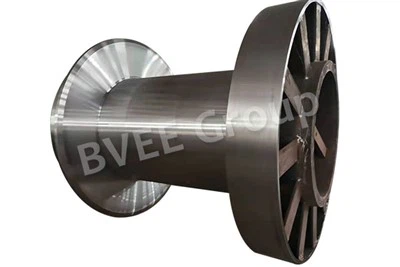
As a supplier of crane hoist drums, I've witnessed firsthand the intricate relationship between drum surface roughness and rope life. This topic is not only crucial for the efficient operation of cranes but also has significant economic implications for our customers. In this blog, I'll delve into the scientific aspects of how drum surface roughness affects rope life and provide insights based on our industry experience.
Understanding Drum Surface Roughness
Drum surface roughness refers to the microscopic irregularities on the surface of the crane hoist drum. These irregularities can vary in size, shape, and distribution, and they are typically measured in micrometers (μm). A smooth drum surface has a lower roughness value, while a rough surface has a higher value. The roughness of a drum surface can be influenced by several factors, including the manufacturing process, material properties, and wear and tear over time.
During the manufacturing process, the drum surface is machined to achieve a specific roughness level. This is usually done through processes such as turning, grinding, or polishing. The choice of manufacturing process depends on the desired roughness level and the specific requirements of the application. For example, drums used in high-precision applications may require a smoother surface finish to minimize rope wear.
Material properties also play a role in determining drum surface roughness. Different materials have different hardness, ductility, and wear resistance, which can affect how the surface wears over time. For instance, a drum made of a hard and wear-resistant material may maintain a smoother surface for longer periods compared to a drum made of a softer material.
The Impact of Drum Surface Roughness on Rope Life
The surface roughness of a crane hoist drum has a direct impact on the life of the wire rope. When the rope comes into contact with the drum surface, the roughness of the surface can cause several types of damage to the rope, including abrasion, fatigue, and corrosion.
Abrasion
Abrasion is one of the most common forms of rope damage caused by drum surface roughness. When the rope slides over a rough drum surface, the microscopic irregularities on the surface act like tiny cutting edges, scraping away the outer layer of the rope. This can lead to a reduction in the rope's diameter, weakening its strength and increasing the risk of failure.
The rate of abrasion depends on several factors, including the roughness of the drum surface, the tension in the rope, and the amount of friction between the rope and the drum. A rougher drum surface will cause more abrasion, especially when the rope is under high tension. Additionally, if the friction between the rope and the drum is too high, it can further exacerbate the abrasion process.
Fatigue
Drum surface roughness can also contribute to rope fatigue. As the rope bends around the drum, the stress distribution within the rope changes. A rough drum surface can cause uneven stress distribution, leading to localized stress concentrations in the rope. Over time, these stress concentrations can cause the rope to develop cracks and fractures, eventually leading to fatigue failure.
The frequency of bending and the magnitude of the stress also play a role in rope fatigue. A rope that is subjected to frequent bending and high stress levels will experience fatigue more quickly. Therefore, minimizing drum surface roughness is essential to reduce the risk of fatigue failure and extend the rope's life.
Corrosion
In addition to abrasion and fatigue, drum surface roughness can also promote corrosion of the wire rope. A rough surface provides more surface area for moisture and contaminants to accumulate, creating an ideal environment for corrosion to occur. Corrosion can weaken the rope's structure, reducing its strength and increasing the risk of failure.
The type of environment in which the crane operates also affects the corrosion rate. For example, in a marine environment, where the air is salty and humid, the risk of corrosion is higher. Therefore, it's important to choose a drum with a smooth surface and to implement proper corrosion prevention measures, such as coating the drum and the rope with a protective layer.
Measuring and Controlling Drum Surface Roughness
To minimize the impact of drum surface roughness on rope life, it's important to measure and control the roughness of the drum surface. There are several methods available for measuring drum surface roughness, including profilometry, optical microscopy, and laser scanning.
Profilometry is a commonly used method for measuring surface roughness. It involves using a stylus to trace the surface of the drum and record the height variations. The data collected by the stylus is then analyzed to determine the roughness parameters, such as the average roughness (Ra) and the maximum peak-to-valley height (Rz).
Optical microscopy and laser scanning are non-contact methods for measuring surface roughness. These methods use light to capture the surface profile of the drum and provide high-resolution images of the surface. They are particularly useful for measuring the roughness of complex surfaces or for detecting small defects on the surface.
Once the surface roughness of the drum has been measured, it can be controlled through various means. One way to control surface roughness is to choose the appropriate manufacturing process. For example, using a finer grinding or polishing process can result in a smoother surface finish. Additionally, regular maintenance and inspection of the drum can help to identify and correct any surface irregularities before they cause significant damage to the rope.
The Economic Implications
The impact of drum surface roughness on rope life has significant economic implications for our customers. Replacing a worn-out wire rope can be a costly and time-consuming process. Not only do customers have to purchase a new rope, but they also have to pay for the labor and downtime associated with the replacement.
By choosing a crane hoist drum with a smooth surface, customers can extend the life of their wire ropes and reduce the frequency of rope replacements. This can result in significant cost savings over the long term. Additionally, a longer rope life can also improve the reliability and safety of the crane, reducing the risk of accidents and downtime.


Conclusion
In conclusion, the surface roughness of a crane hoist drum has a profound impact on the life of the wire rope. By understanding the scientific principles behind this relationship and taking appropriate measures to control drum surface roughness, we can help our customers extend the life of their wire ropes, improve the efficiency of their cranes, and reduce their operating costs.
If you're in the market for a high-quality STS Crane Hoist Drum or Crane Wire Rope Drum, we invite you to contact us to discuss your specific requirements. Our team of experts is ready to provide you with the best solutions and support to meet your needs.
References
- "Wire Rope Handbook" - This comprehensive guide provides in-depth information on wire ropes, including their construction, properties, and applications.
- "Crane Design and Operation Manual" - A valuable resource for understanding the design and operation of cranes, including the role of hoist drums and wire ropes.
- Industry research papers on the impact of surface roughness on mechanical components, which provide scientific insights into the relationship between drum surface roughness and rope life.